ByMinh Trang
Jun 5, 2026
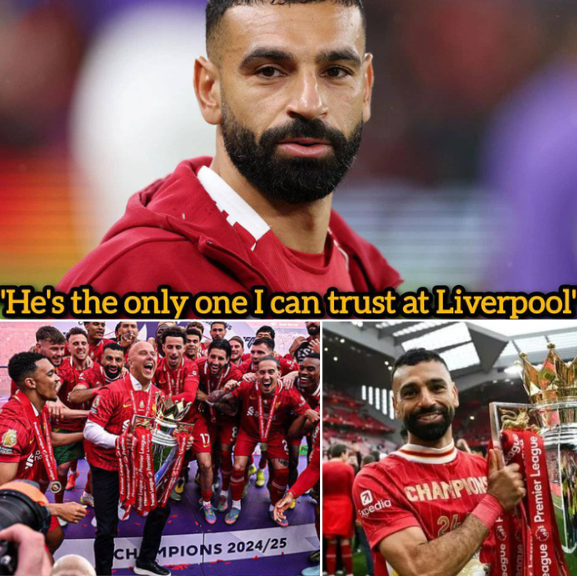
There is a specific kind of silence that falls over Anfield when the weight of history is being rewritten. It is not a silence of emptiness, but one of anticipation. For nearly a decade, the narrative of Liverpool Football Club has been inextricably linked to the name Mohamed Salah. He has been the symphony of thunder, the precision of a master watchmaker, and the defining icon of an era that saw the Reds conquer both England and Europe.
But every era has a curtain call.
In a stunning, wide-ranging interview with Egyptian media this week, a departing Mohamed Salah did not simply offer the customary platitudes of a player moving on to new pastures. Instead, he delivered a manifesto—a parting gift that has sent shockwaves through the fan base and shifted the entire discourse surrounding the club’s future.
The quote, now transcribed and debated across every digital corner of the football world, stands as one of the most significant endorsements in the history of the modern game:
“Many people focus on the players when discussing the 5th-place finish, but there is one young player in that dressing room who gave everything he had for this club every single day. While some individuals struggled with frustration behind the scenes, his professionalism, dedication, and effort never wavered. I truly believe he represents Liverpool’s future, and the club should make him a central figure in the next chapter of its project.”
This was not just a compliment. It was a baton pass.
The Context of the Storm
To understand the magnitude of Salah’s comments, we must first look at the wreckage of the 2025/2026 season. A 5th-place finish, by the standards of a club that had grown accustomed to title charges and Champions League glory, was a disappointment—perhaps even a crisis.
Behind the scenes, the atmosphere was, by all accounts, volatile. The pressure of maintaining a championship-level output, combined with the inevitable fatigue of a long-term project, created cracks in the dressing room. Salah, as a senior figure, saw these cracks firsthand. When he speaks of “frustration behind the scenes,” he is referencing a truth that many fans suspected but few had confirmed: the internal toll of a season that simply wouldn’t go right.
In this context, Salah’s praise becomes more than just hyperbole. It is a defense of meritocracy. By singling out a younger player who kept his head down while others were, perhaps, looking for exits or succumbing to the toxicity of underachievement, Salah is signaling what he believes is the vital ingredient for Liverpool’s resurrection: character over clout.
The Mystery of the Chosen One
The immediate aftermath of the interview was a frenzy of detective work. Who is the player?
Social media has been a chaotic hive of speculation. Every young prospect in the Liverpool academy and the first-team squad has been scrutinized. Is it the energetic midfielder who tracked back when the rest of the team felt heavy-legged? Is it the young defender who stepped into the breach during the mid-season injury crisis?
The beauty of Salah’s ambiguity is that it forces the fans—and the management—to look closer at the squad. It forces them to stop looking at the names on the back of the shirts that fetch the highest transfer fees and instead look at the people who actually did the work.
Whoever that player is, they have just received the greatest endorsement imaginable. To be championed by Salah is to be anointed by royalty. The pressure on this individual will be immense, but so will the support of the Kop, which has always been loyal to those who show “heart” above all else.
The Salah Doctrine: Why He Chose Now
Why would a player of Salah’s stature—a man who has nothing left to prove—take the time to shine a light on someone else?
The answer lies in the nature of legacy. For Salah, Liverpool is not just a club he played for; it is a project he helped build. Leaving isn’t just about his career; it’s about the sustainability of what he is leaving behind.
By identifying a leader for the “next chapter,” Salah is attempting to control the narrative of his own exit. He is essentially saying: My story here is ending, but the story of this club must continue.
He is providing the blueprint for the next manager and the recruitment team. He is telling them, in no uncertain terms: “This is who you build around. Don’t look for the shiny new toy in the transfer market. Look at what you already have.”
The Sociological Shift: Mentorship in the Modern Game
Sociologically, this moment is a fascinating study in celebrity and institutional hierarchy. We often see veteran players protect their own status, creating a gatekeeper dynamic where the established order is preserved at all costs.
Salah has done the opposite. He has actively disrupted the hierarchy. He has identified that the old guard—those who may have been struggling with the “frustration” he alluded to—are not the path forward.
This is a profound act of self-effacement. It suggests a level of maturity that transcends the ego of the superstar. It is the acknowledgement that a football club is an organism, not just a collection of assets. By placing his immense influence behind a developing talent, he is trying to bridge the gap between the era of dominance he helped create and the era of uncertainty that follows.
The Burden of the Endorsement
Of course, this comes with a heavy burden. The unnamed player, when revealed (or even if they choose to remain anonymous in their own right), will now carry the weight of Salah’s expectation.
Can they live up to it? The history of football is littered with “the next big thing” who failed to reach the summit. But Salah’s endorsement is different. He isn’t praising raw talent or flashy skills; he is praising professionalism and consistency. Those are the traits that survive the transition from prospect to legend.
Salah is not betting on a talent; he is betting on a mindset.
The Passing of the Torch
Could this be the ultimate “passing-of-the-torch” moment?
If we look at the history of Liverpool, there are specific moments where the baton is handed over—from Souness to Barnes, from Gerrard to Henderson. These are the moments that define the club’s DNA.
Salah’s interview may be the most unconventional of these transitions. It isn’t a hand-picked successor in a photo op. It is a challenge—a challenge to the player to step up, and a challenge to the club to recognize value when it is standing right in front of them.
Conclusion: The Architect’s Final Design
As the dust settles on the shockwaves of this interview, the reality of the post-Salah era begins to sink in. Anfield will be a different place. The rhythm of the attack, the standard of the training ground, the morale of the dressing room—all of it will have to be recalibrated.
But in this final act of leadership, Salah has provided a map. He has shown that even as he prepares to walk out of the tunnel for the last time, he is still thinking about the next goal, the next trophy, and the next victory.
The player he endorsed may not be the one we expect. They may not be the one with the most social media followers or the most dazzling highlight reel. But as we look toward the future, the message is clear: Liverpool FC is not defined by the icons who leave, but by the ones who stay, the ones who work, and the ones who have the character to carry the torch when the lights go out.
Mohamed Salah has done his part. The rest, as they say, is up to the next generation.